
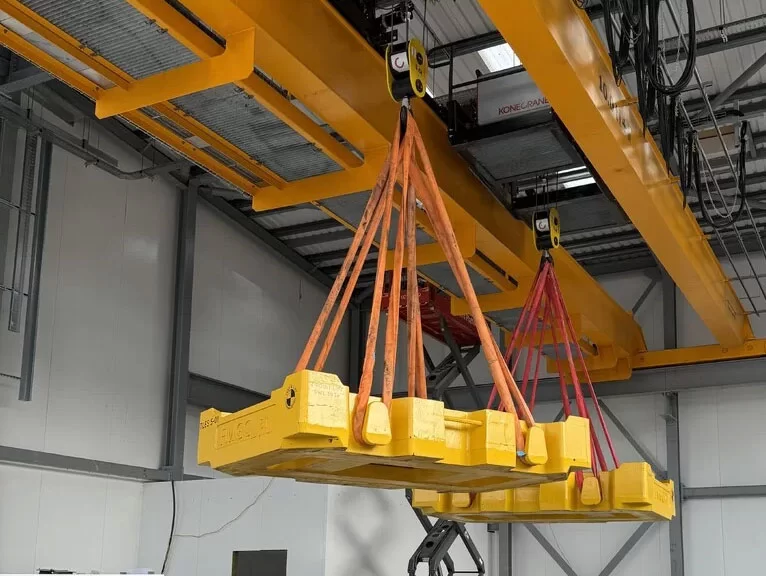
The requirement for proof load testing lifting equipment generally starts when the designer or manufacturer of a component specifies the design load, operational load and proof load of the component and the standard it is being designed in accordance with.
Most components are designed in accordance with national standards and regulations — for example BS EN ISO standards, Supply of Machinery (Safety) Regulations 2008 and Health and Safety at Work Act 1974 — however for components that fall outside the available standards, companies often develop their own in-house standards.
For the sake of this discussion, definitions are as follows, though it is always worth checking definitions when reviewing any standard or report:
- Design load – typically this is the load the component should withstand without permanent deformation or failure.
- Operational load – the maximum operational load, most widely referred to as SWL or WLL.
- Proof load – typically a load between the operational load and the design load, often expressed as a percentage of the SWL or WLL.
Why and when are proof load tests required?
Proof load testing validates the strength and integrity of lifting equipment and load-bearing structures to ensure they can safely handle expected loads without failing.
Whilst the proof load test requirements are dictated by the design standard, they are typically required:
- Before lifting equipment’s first use
- After assembly and installation (e.g. overhead cranes)
- After significant alteration or maintenance
- When deemed necessary by a LOLER inspector
- At significant milestones during the equipment’s lifespan — this usually depends on the type of equipment and the applicable regulations and standards. DNV containers are a good example of this, with periodic load tests detailed in the standard.
If in doubt, get in touch and we can provide guidance on this.
How is lifting equipment tested?
A fundamental requirement of a load test should be to replicate as closely as possible the direction and magnitude of forces the component is designed to withstand.
Precautions should always be taken prior to load testing to minimise the risk of failure – examples of these are material control, weld control, NDT and visual examinations. Only when all reasonable precautions have been taken should load testing commence. Normally the loads should always be increased slowly and generally the operational load is applied prior to the proof load.
A poorly designed load test can be pointless – applying force locally to a pad eye fitted to a large load bearing structure only verifies the integrity of the design and material immediately around the pad eye. Normally hydraulic jacks are utilised for these tests. The images below show the stress levels and distribution in a lifting beam when the load is applied to just the upper pad eye and then to both the upper and lower pad eyes. In both instances the load applied is identical.
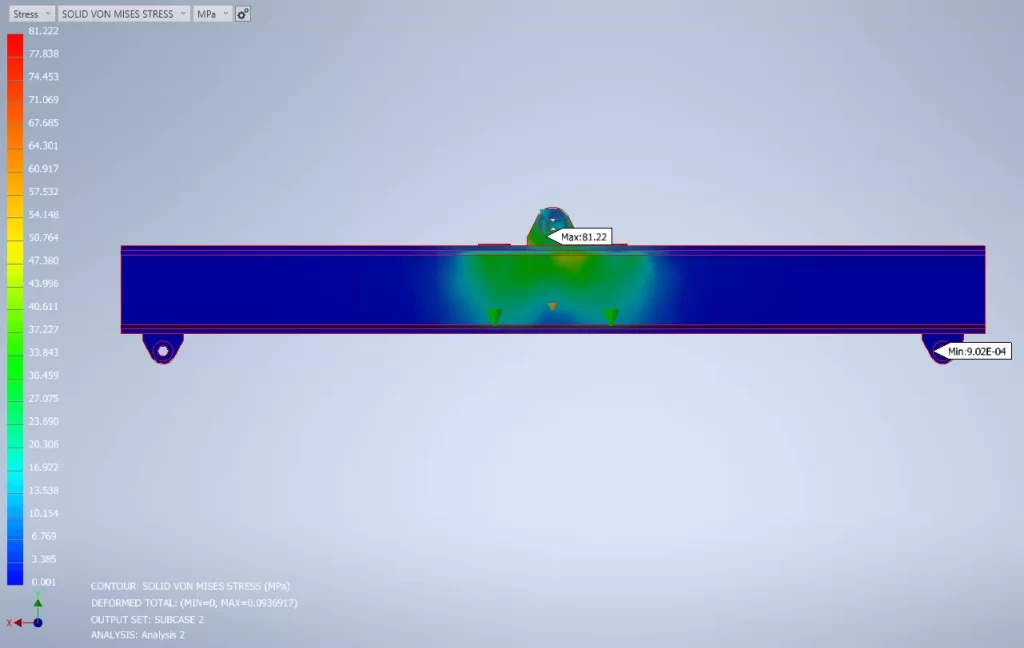
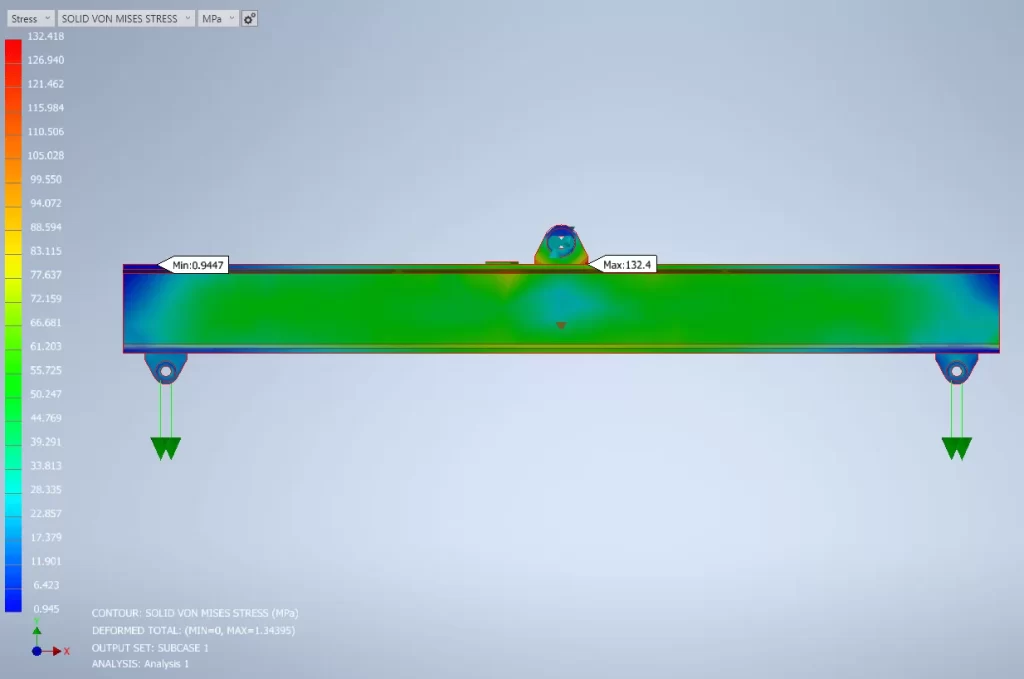
With a local test of a pad eye the forces in the whole structure do not replicate the design forces. In this instance an incorrectly specified beam section or a material defect in the beam would not be identified during the test procedure.
When the whole unit is load tested the forces in the whole structure replicate the design forces. Normally test weights or a test machine are utilised for these tests.
Whilst some of the more stringent design standards stipulate testing the whole structure there can be situations where local testing of structures is technically acceptable.
Regardless of the test method, hold time at load should be considered – we have witnessed plenty of tests where the structure appeared to be withstanding the load immediately after application only to fail after a few minutes. The hold time tends to be stipulated in the more stringent design standards.
If in doubt, get in touch and we can provide guidance on this.
Why test with weights?
Testing with weights tends to make it easier to replicate the operational forces than with other methods, especially with more complex and larger components.
Note that test weights are seldom used when intentionally testing a part to failure – with these tests hydraulic force is generally utilised. Testing to destruction is a separate topic completely.
Test weights are easy to transport to site and are the most practical solution for testing items that cannot be transported to a testing facility.
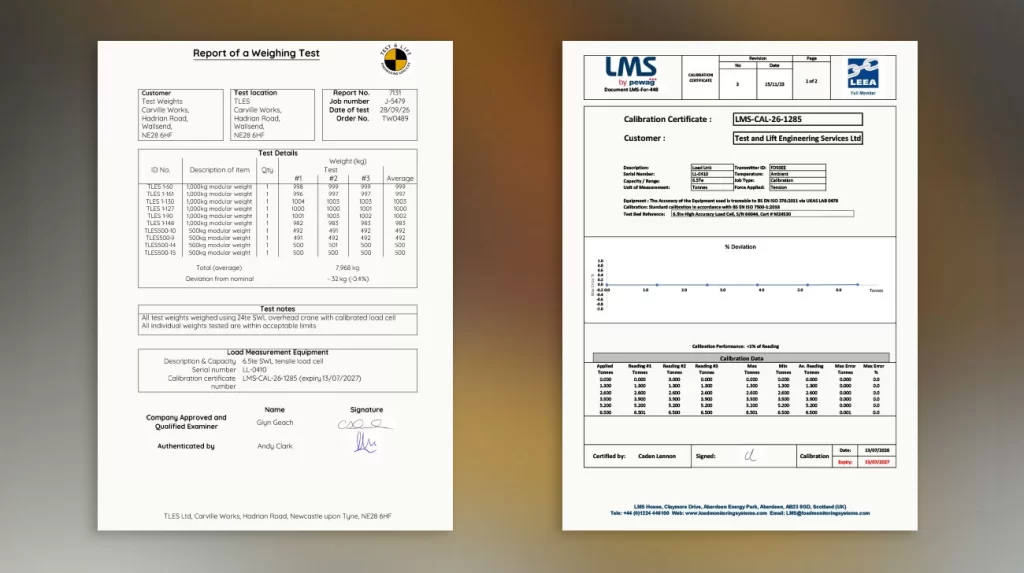
Typically, the accuracy of weights 1,000kg or over is +/- 2% and they tend not to be calibrated – normally the test loads are verified by utilising a calibrated load cell either in the rigging arrangement during the test or prior to use. All of our test weights can be provided with a weighing test report to save time on site, utilising calibrated load cells traceable to national standards.
Pitfalls to avoid when testing with weights
- Weights are difficult to handle and assemble.
- Often weights have no dedicated lift points or inaccessible lift points.
- Weights supplied with no instructions or lift plan.
- With the variety of weight sizes provided it is difficult to produce drawings or plans for use on site.
- Weights liable to damage rigging with features like sharp or rough corners.
- Weights are difficult to secure.
- Often there is a high reliance on lashing rather than a more positive method of securing. Cargo lashing straps are often more for show than being effective in stopping a stack of sliding steel weights.
- Poor documentation supplied with test weight cradles with safe capacity based on experience rather than science.
- Poor design of test weight cradle pad eyes.
- A common failing in the design of test weight cradles is their lifting eyes – often they are configured so they are not aligned with the applied force and are side loaded when in use.
- Poor marking or lifting and lashing points.
- Difficult to adjust weight and centre of gravity.
Why our test weights make the job easier
- Easy to handle and arrange.
- Handling slings supplied with each hire.
- Self-securing.
- No cradles required for loads under 30,000kg.
- Easy to produce balanced loads.
- Purpose built and certified cradles.
- Drawings and CAD files of all weights available on request.
- Bespoke arrangement drawings available to support on-site activities.
- Standard sizes throughout the range.
- One of the country’s largest stocks of test weights held in depots around the UK.
To find out more about our test weight hire service or to discuss your proof load testing requirements, get in touch.
Call us on 0191 432 9343, email hire@test-weights.co.uk or complete our enquiry form.

